If a brand film and a website refresh are both on this year’s plan, plan them together. The site needs the same people, places and products as the film: a hero loop, short section clips, portraits, stills and product details. Agree the page plan and the formats before the shoot, then capture both on the same days. Nowa Film is a Toronto video production company that also designs and builds websites, so we see both sides of that handoff.
Why plan the film and the site at the same time?
The shoot is the expensive day to repeat. Planned separately, a new site can end up with stock photography, or with a second shoot that asks the same people for another day. Planned together, the site’s media comes from days already in the film budget, lit and graded to match the film.
There is a quieter benefit. Writing the home page forces the same decision a brand film needs: what the company does, and for whom, in one sentence. Settle that sentence once and both projects use it. When the film and the headline say the same thing, each makes the other easier to believe.
What should you film for the website?
Start from the page plan, not the camera. List each page and each section that will carry a still, a clip or a loop, then add those shots to the film’s shot list and mark which ones serve the film, the site or both.
| Site element | What to film | What to agree before the shoot |
|---|---|---|
| Home page hero loop | One slow, continuous move with no cuts, about 8 to 12 seconds, ending close to where it began | Desktop and phone crops, where the headline sits, the poster frame |
| Section clips | Short single-action shots, one idea each: the product in use, a process, the team at work | Which sections move and which stay still; wide, square or tall framing |
| Portraits | Team and founder portraits in one light and backdrop, plus a few seconds of motion | Who appears, wardrobe, releases, crops for cards and the about page |
| Stills and frame grabs | A stills pass during the shoot; frame grabs from the film for covers and social cards | Which images need print or full-screen size, and whether a photographer is booked |
| Product details | Close shots of materials, finishes, screens and hands in use, on clean backgrounds | Which products appear, and clean versions with no text or logo animation |
| Space for words | Calm frames with an empty area where a headline can sit | Headline length and its position on desktop and on a phone |
| Interview answers | Complete answers that make sense as a quote on a page | Permission to quote, transcripts and captions |
A film moves on quickly; a web page holds a shot for as long as someone reads beside it. Ask for a few longer, steadier takes of the moments that matter, and for each product shot before the hands come in. Frame grabs from the film work for page covers and social cards. For a team page or anything printed, book a stills pass so the portraits are sharp and match each other.
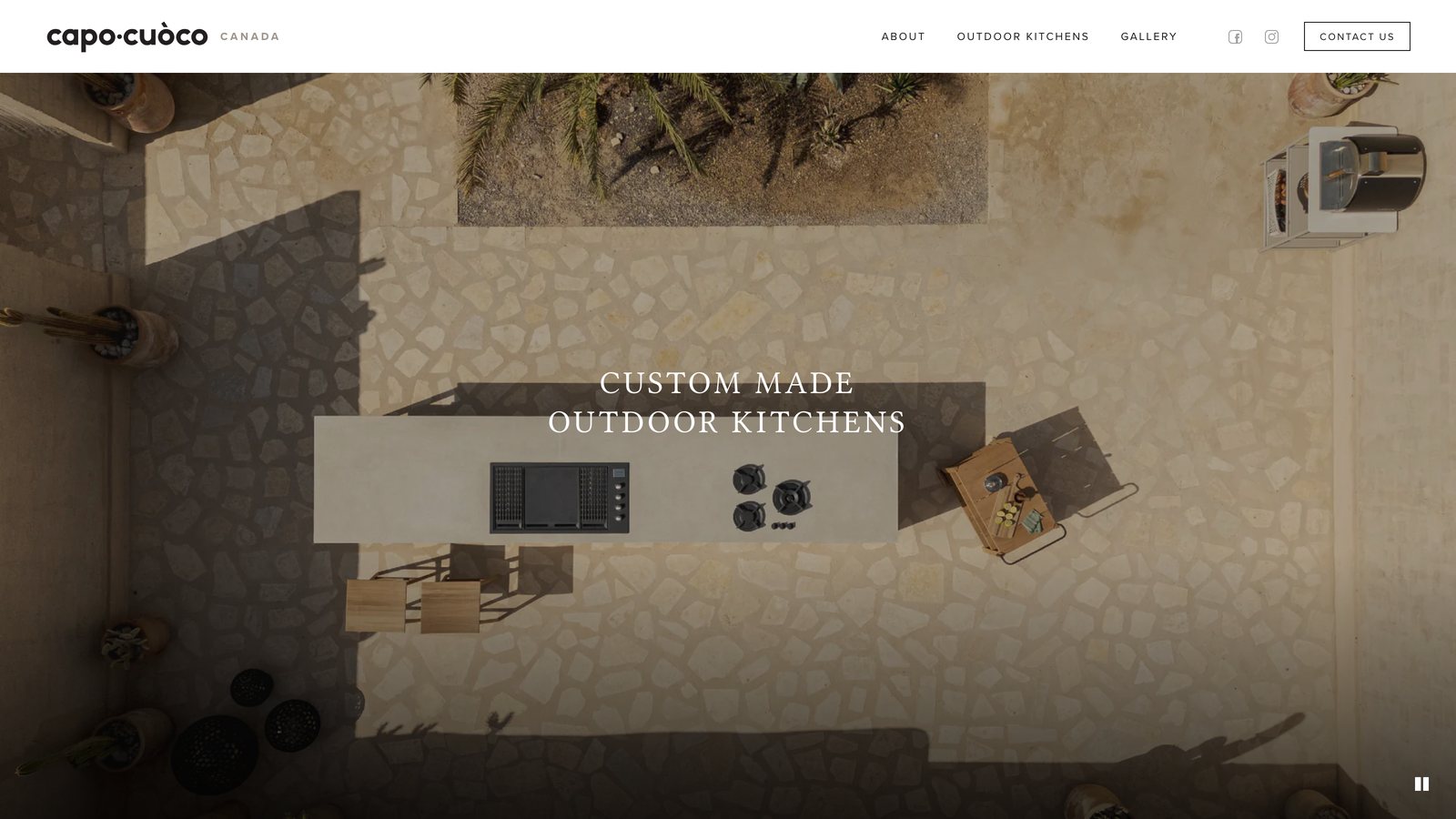
One site we designed and built shows the pattern. On capo-cuoco.ca, for an outdoor kitchen brand, large photography carries a page per collection, with planning guides alongside. The lesson for a shoot: plan images strong enough to hold a whole page, and the written guidance that sits next to them.
Formats and specs to agree before the shoot
Video on a website goes wrong in predictable places. Settle these in writing before the shoot day:
- Aspect ratios: the wide frame for the film, a tall or square crop for phones, and the shape of each section that will carry a clip.
- Loop length and the cut point, so the hero loop restarts without a visible jump.
- Poster frames: the still shown before playback starts, and in place of the video if it does not load.
- Sound: hero loops and section clips run silent, so nothing essential depends on audio.
- Captions: a separate caption file for every film with speech, as well as any version with captions burned in.
- File weight: short loops as small, compressed files; longer films streamed through a player that adjusts quality to the connection, not loaded as one large download.
- Colour: one grade across the film, the loops and the frame grabs, so the site reads as one shoot.
Several of these change how shots are framed. A phone crop needs room above and below the subject, and a loop needs a camera move that can end where it began. Our guide to vertical and widescreen framing covers when a crop holds and when a shot needs its own pass.
Captions, reduced motion and accessibility
In Ontario, businesses and non-profits with 50 or more employees must make public websites meet WCAG 2.0 Level AA, according to the province’s website accessibility guidance. Two parts of WCAG 2.0 bear directly on a film-led site. Pre-recorded video with sound needs captions. Moving content that starts on its own, lasts more than five seconds and plays alongside other content needs a way to pause, stop or hide it. A hero loop that keeps repeating therefore needs a pause control, however short the clip itself.
Respect the visitor’s motion setting as well. Phones and computers let people ask for less motion, and a site can detect that setting. When it is on, show the poster frame instead of the loop. The poster frame then has to work as a photograph in its own right, which is one more reason to plan it on set rather than pick it in the edit.
How the words around a film help search and AI answers
Do not rely on a search engine or an AI assistant to watch the film. Put the sentence that says what the company does in text on the page, near the film, not only in its voiceover. Give each film a descriptive title, a short paragraph on what it shows and who it is for, and a transcript where speech carries the message.
A transcript does two jobs: it serves people who cannot listen, and it puts the film’s words on the page. The Arctec AI site we designed and built, arctecai.com, takes the plain route: service pages that say what each service is, and pricing in the open. Our note on making a brand clearer in ChatGPT and Google covers the wider page work. For a film-led site, the habit that matters is writing the context while the film is being made, when everyone still remembers why each scene is there.
What does a brand film and a website cost together?
Each is quoted to its own scope. Our video production work, which includes brand films, usually costs $3,500 to $25,000 CAD. Websites usually cost $4,500 to $25,000, with Google SEO built in, and the AI SEO and GEO add-on starts from $150 per month. Both ranges are on our rates page.
What planning them together changes is where the site’s media comes from: shots captured on days already in the film budget, rather than a second shoot or a stock library. Our website scope guide covers the rest of a site quote, from content to migration.
A planning order for both projects
- Agree the message: what the company does, for whom, in one sentence the film and the home page can share.
- Draft the page plan: the pages, their sections and where each needs a still, a clip or a loop.
- Merge the shot lists, marking which shots serve the film, the site or both.
- Agree formats, loop lengths, poster frames, captions and file delivery in writing.
- Shoot, with time set aside for site-only takes: holds, details, portraits and stills.
- Edit the film first, then pull loops, clips and frame grabs in the same grade.
- Build the pages with the real media, then test on a phone, on a slow connection and with reduced motion switched on.
Steps one to four all happen before the shoot day, and they decide whether the site gets its media from the shoot or from a second budget.
Quick answers
Should we film website content on the same shoot as our brand film?
If the site is being refreshed in the same period, yes. The same people, places and products appear in both, and the crew and light are already booked. Add the site’s shots to the film’s shot list: a hero loop, short section clips, portraits, stills and product details, with formats and poster frames agreed before the shoot day.
What video formats does a website need?
Agree aspect ratios for desktop and phone, a short silent hero loop that restarts without a visible jump, a poster frame for every video, caption files for films with speech, and how longer films will stream rather than load as one large file. Settle these before the shoot, because several of them change how shots are framed.
How much does a brand film and a website cost?
At Nowa Film, a Toronto video production company, video production including brand films usually costs $3,500 to $25,000 CAD, and websites usually cost $4,500 to $25,000 with Google SEO built in. An AI SEO and GEO add-on starts from $150 per month. Each is quoted to its scope; planning both together lets the site’s media come from the same shoot.
 Google Meet